
The Schöningen Spears: The Weapons That Rewrote Human History
Discover the Schöningen Spears, the world's oldest complete wooden hunting weapons. Dating to around 300,000 years ago, they transformed our understanding of early human intelligence, technology, and cooperative hunting.
FIELD NOTES
Aro
6/29/20263 min read
The Schöningen Spears: The Weapons That Rewrote Human History
For much of the twentieth century, archaeologists believed that early humans were little more than opportunistic scavengers, collecting meat from animals killed by predators. Then a discovery, in the 1990s changed everything. Buried beneath the sediments of an ancient lakeshore in northern Germany, archaeologists uncovered a collection of beautifully preserved wooden spears dating to around 300,000 years ago.
The discovery transformed our understanding of prehistoric hunters and revealed that our ancient relatives were far more intelligent, organized, and technologically skilled than anyone had imagined.
A Rare Window into the Wooden Age
Most prehistoric tools were made from wood. The problem is that wood almost never survives for hundreds of thousands of years. At Schöningen, however, the weapons were buried in waterlogged lake sediments where oxygen was almost completely absent. These exceptional conditions preserved not only the spears but also hundreds of wooden artifacts, animal bones, plant remains, and traces of the surrounding environment. For archaeologists, it was like opening a time capsule from the Middle Pleistocene.
Precision Engineering 300,000 Years Ago
The complete spears measure between 1.8 and 2.5 meters (6–8 feet) in length and were carved primarily from slow-growing spruce trees. They were anything but simple. The makers deliberately positioned the hardest part of the trunk toward the spear tip while shifting the softer pith away from the center, producing stronger and more durable points. Each spear was carefully debarked, shaped, scraped smooth, and balanced with remarkable precision.
Several spears even show evidence of repair after being damaged during use, demonstrating that these valuable weapons were maintained rather than discarded.
More Than Just Spears
For nearly thirty years, Schöningen was famous for its wooden spears. But a comprehensive study published in 2024 researchers identified 187 worked wooden artifacts, including at least 10 spears, 7 throwing sticks, and 35 additional wooden tools likely used for domestic activities such as hide processing and woodworking. Some broken weapons had even been recycled into smaller tools, providing the earliest known evidence of systematic wood recycling in the Paleolithic.
Instead of a single hunting episode, Schöningen now appears to have been a repeatedly occupied lakeside camp where hunting, butchery, tool maintenance, and everyday life all took place.
Hunters, Not Scavengers
The wooden weapons were discovered alongside thousands of animal bones, particularly horses that had been butchered using stone tools. This association fundamentally changed one of archaeology's biggest debates. Rather than scavenging carcasses left by predators, the people at Schöningen were clearly active hunters capable of coordinating attacks on large animals. Such hunts would have required planning, communication, cooperation, and a detailed understanding of animal behavior. The site offers some of the earliest direct evidence for organized group hunting in human evolution.
Who Made the Spears?
No human fossils have yet been recovered from Schöningen.
For many years, the weapons were generally attributed to Homo heidelbergensis, one of the ancestors of Neanderthals. More recent research has suggested that the site may be younger than originally believed, raising the possibility that early Neanderthals were responsible instead. Regardless of which species crafted them, the message remains the same: these people possessed advanced woodworking skills, sophisticated hunting strategies, and the ability to cooperate in complex social groups.
Why Schöningen Still Matters
The Schöningen Spears remain the oldest complete wooden hunting weapons ever discovered. More importantly, they remind us that the archaeological record is deeply biased. Stone survives. Wood usually does not.
If these remarkable weapons had not been preserved beneath waterlogged sediments for hundreds of thousands of years, we might still believe that early humans lacked advanced technology. Instead, Schöningen reveals a very different story—one in which careful planning, expert craftsmanship, and cooperative hunting were already shaping human evolution long before our own species appeared.
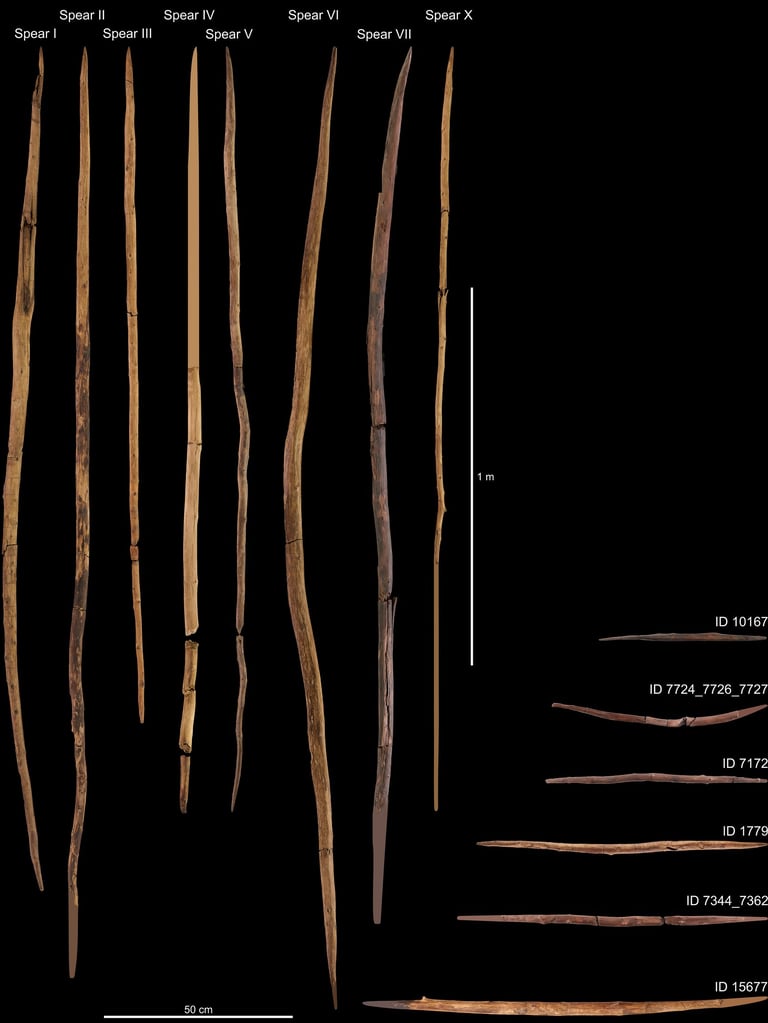
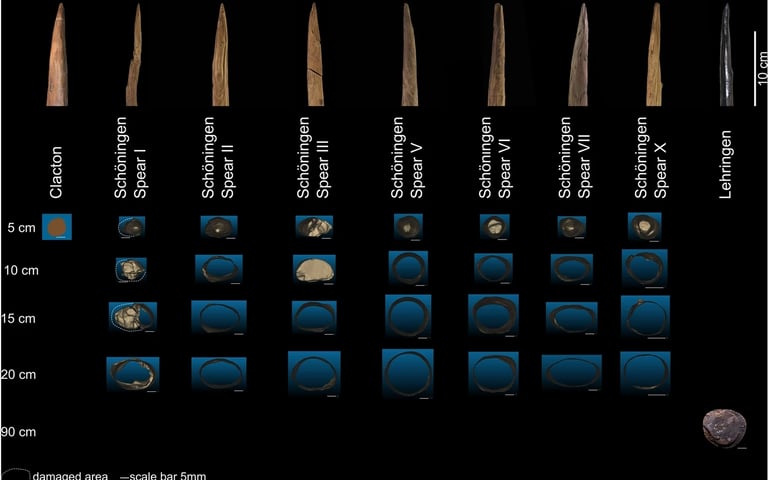
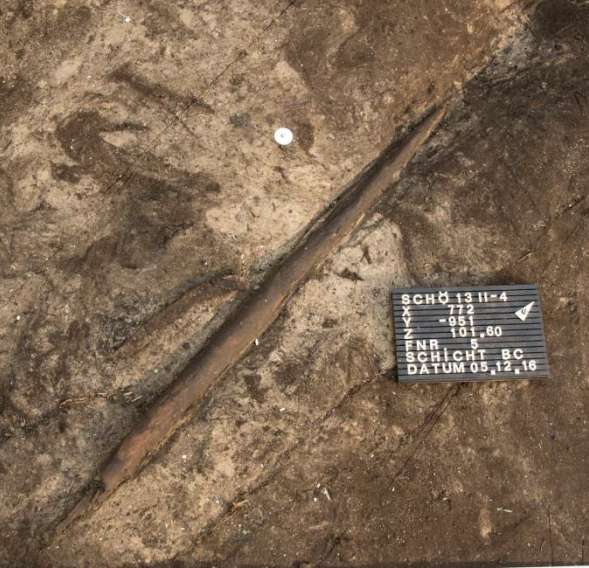
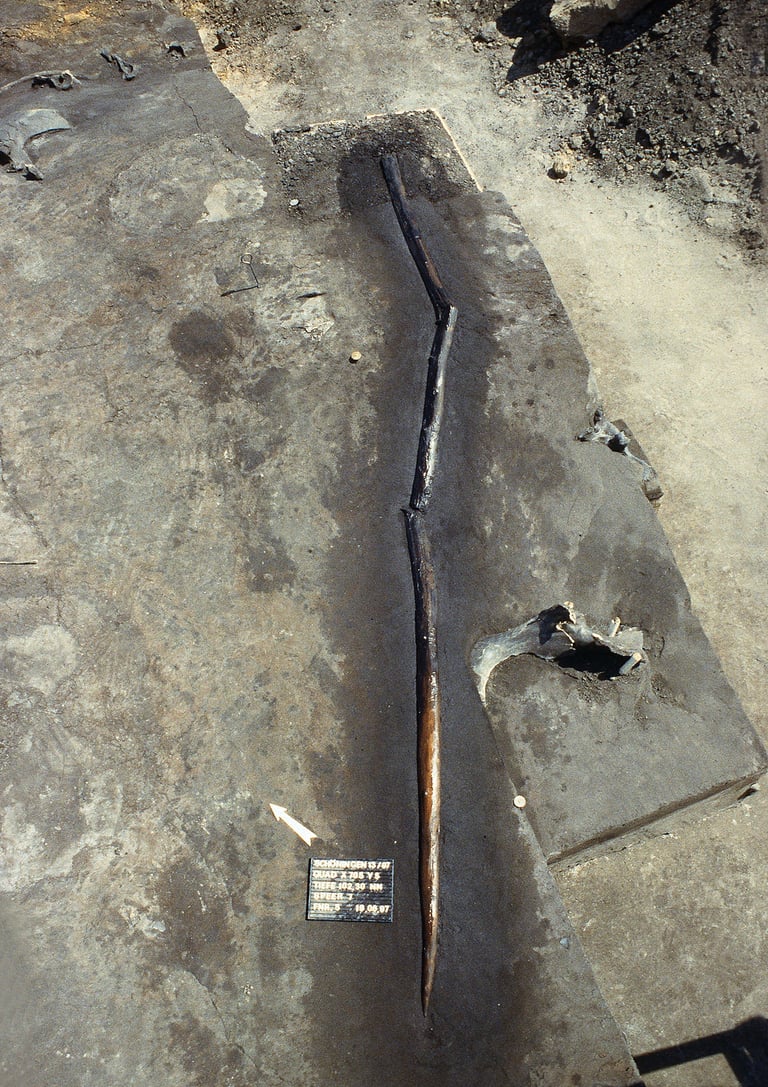
Schöningen spears
300000 - 200000 Years Ago
