
The Blanchard Bone Fragment
Discovered in Ice Age France, the Blanchard Bone Fragment is covered with mysterious engraved marks that some researchers believe represent one of humanity's earliest lunar calendars. Explore the debate surrounding this remarkable Upper Paleolithic artifact.
FIELD NOTES
Aro
6/17/20262 min read
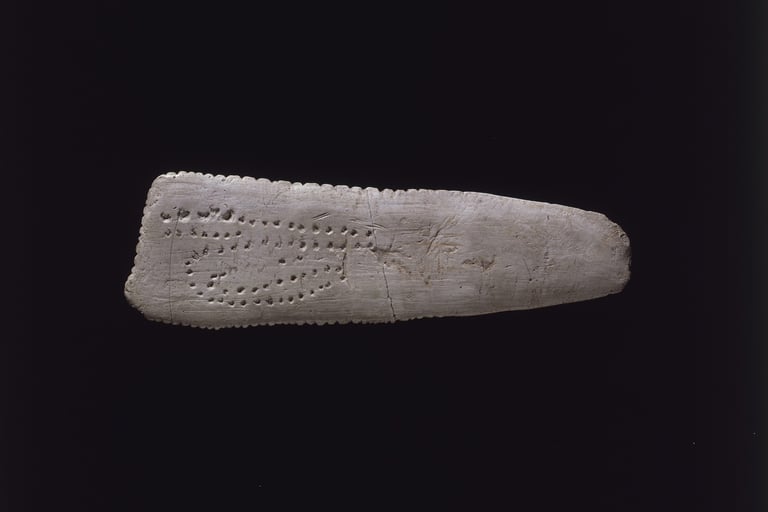
The Blanchard Bone Fragment: Humanity's First Lunar Calendar?
In 1911, archaeologists excavating the Aurignacian site of Abri Blanchard in southwestern France uncovered a small fragment of reindeer bone covered with carefully engraved marks.
At first glance, it appears unremarkable. There are no animal figures or elaborate carvings—just rows of dots and lines. Yet this small artifact may represent one of humanity's earliest attempts to record the passage of time.
Dating to approximately 30,000 years ago, the Blanchard Bone Fragment has become one of the most debated objects from the Upper Paleolithic.
A Mysterious Pattern
The artifact was discovered in the Vézère Valley, one of Europe's richest prehistoric regions. The engraved marks are arranged in distinct groups that appear deliberate rather than random.
For decades, archaeologists struggled to explain their purpose. Were they decorative? A counting system? Or something more complex?
The most influential interpretation came from researcher Alexander Marshack in the 1960s and 1970s.
Tracking the Moon
Using microscopic analysis, Marshack proposed that the marks represented observations of the Moon's changing phases. According to his interpretation, the engravings recorded a lunar cycle of roughly 29.5 days.
If correct, the Blanchard fragment would be one of the earliest known examples of timekeeping in human history.
Marshack argued that Upper Paleolithic people were not simply creating art. They were observing recurring natural events and recording information in a systematic way. The object may have helped track seasons, animal migrations, or other important environmental changes.
An Early Information Technology?
More recently, researchers have suggested that artifacts like the Blanchard fragment may have functioned as external memory devices.
Instead of relying entirely on memory, people could store information in physical objects. The engraved marks may have helped organize observations, preserve knowledge, and communicate patterns across time.
In this view, the fragment represents more than a calendar. It may be evidence that Ice Age humans were developing increasingly sophisticated ways of thinking about abstract concepts such as quantity, cycles, and time itself.
The Debate Continues
Not everyone accepts the lunar-calendar interpretation.
Critics argue that groups of notches can be interpreted in many different ways and that there is no definitive proof the engravings relate to the Moon. The marks may have recorded something entirely different—or perhaps had no numerical meaning at all.
This uncertainty is part of what makes the artifact so fascinating. Unlike written records, prehistoric symbols rarely come with explanations.
Why It Matters
Whether it was a lunar calendar, a tally system, or something we have yet to understand, the Blanchard Bone Fragment demonstrates that Ice Age people were capable of complex symbolic thought.
Thirty thousand years ago, humans were not only creating remarkable art. They may also have been developing ways to record information, track recurring events, and make sense of the world around them.
The Blanchard Bone Fragment remains a small object with enormous implications—offering a rare glimpse into the minds of some of Europe's earliest modern humans.
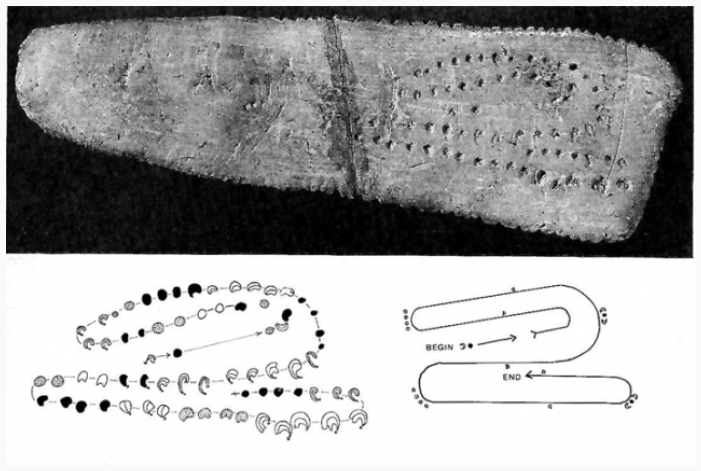
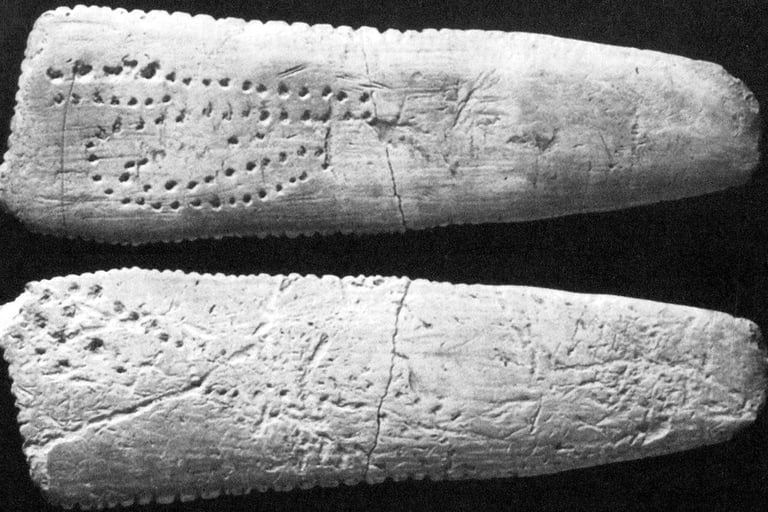
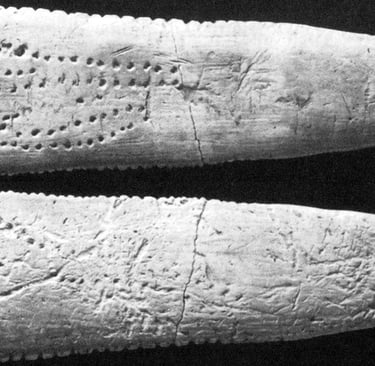

The Calendar Bone Tablet
30000-20000 Years Ago