
The Adorant
Discovered in Germany's Geißenklösterle Cave, the Adorant is a tiny mammoth ivory carving dating to around 40,000 years ago. Depicting a figure with raised arms and surrounded by mysterious notches, it has been interpreted as a worshipper, a hybrid being, a fertility symbol, and even an astronomical record. Explore one of the most enigmatic artifacts of the Ice Age.
FIELD NOTES
Aro
6/16/20262 min read
The Adorant of Geißenklösterle: A 40,000-Year-Old Mystery
Among the remarkable Ice Age discoveries from Germany's Swabian Jura, few artifacts are as intriguing as the Adorant of Geißenklösterle.
Carved from mammoth ivory around 40,000 years ago, this tiny object measures just 3.8 centimeters in length. Yet despite its size, it has sparked decades of debate among archaeologists.
The artifact was discovered in 1979 at Geißenklösterle Cave, one of Europe's most important Upper Paleolithic sites. Created by Aurignacian hunter-gatherers, it belongs to the same cultural tradition that produced the famous Lion-Man and some of the world's oldest musical instruments.
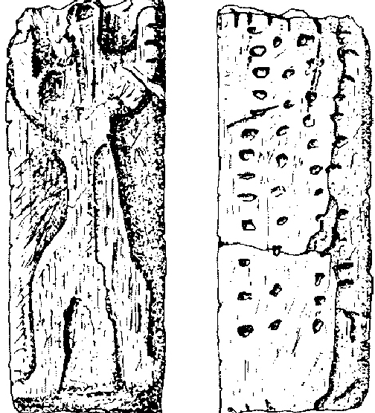
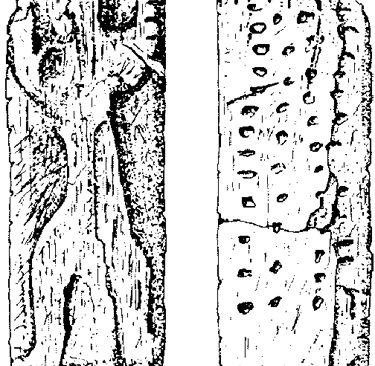
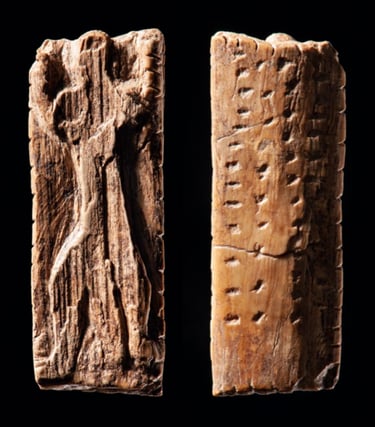
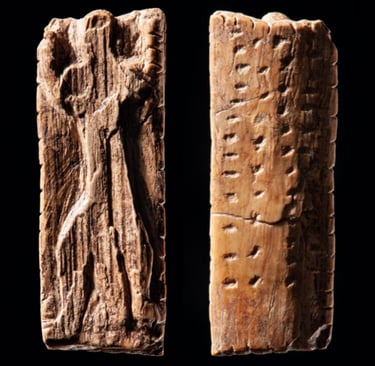
On the front of the ivory plaque is a stylized figure with raised arms and spread legs. This unusual pose led researchers to nickname it "The Adorant"—the worshipper. Some archaeologists believe it may represent one of the earliest depictions of ritual or spiritual behavior ever created.
A curious extension between the legs has been interpreted in different ways: as a tail, a phallus, a ritual garment, or even evidence that the figure represents a human-animal hybrid. Some researchers have suggested similarities with the Lion-Man, another famous Ice Age carving from the region.
The greatest mystery, however, lies in the markings carved around the object. Archaeologists have identified approximately 88 notches arranged along the edges and back of the plaque. Their purpose remains unknown.
Some scholars have proposed that the marks represent lunar cycles, turning the object into a form of Ice Age calendar. Others have linked them to fertility and pregnancy, while more speculative interpretations connect them to observations of the night sky.
Recent research has added another possibility. Rather than being purely decorative, the marks may have formed part of an early system for recording information. If so, the Adorant could represent more than art or ritual—it might preserve evidence of how some of Europe's earliest modern humans organized and communicated knowledge.
Today, the Adorant remains one of the most enigmatic objects of the Upper Paleolithic. Was it a spiritual figure, a mythological being, a calendar, or something else entirely?
Forty thousand years after it was carved, the answer remains elusive. And perhaps that is exactly what makes this small piece of mammoth ivory so fascinating.



The Adorant
40000 Years Ago